
Topsky Firefighting Reconnaissance Modeling Robot
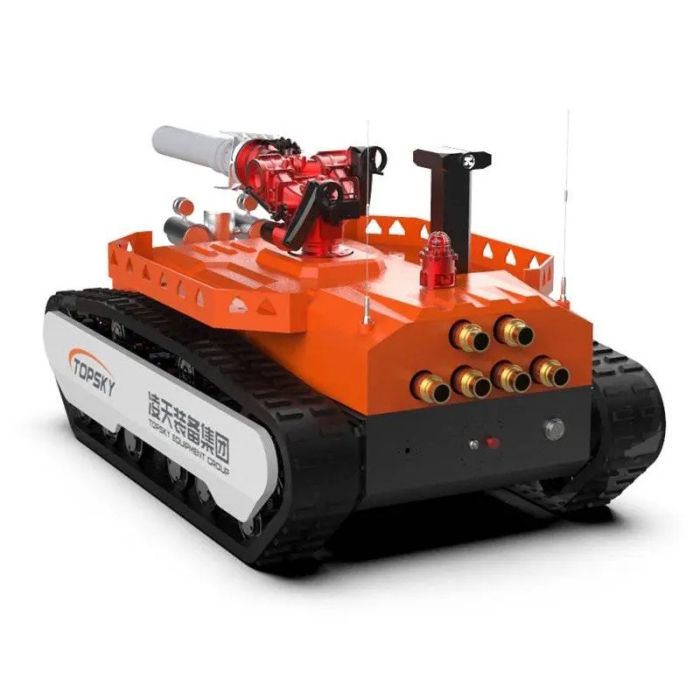
Disponible
- MARCA:
- TOPSKY
- NÚMERO DE PIEZA #:
- Firefighting reconnaissance modeling robot
- ORIGIN:
- China
- Warranty:
- 12 MESES
- AVAILABILITY:
- SUBJECT TO AVAILABILITY
- SKU:
- Topsky-Firefighting-Reconnaissance-Modeling-Robot
Topsky Firefighting Reconnaissance Modeling Robot
Topsky Firefighting Reconnaissance and Modeling Robot
A reconnaissance platform built around a rotating lidar scanner: it captures spatial three-dimensional data of an incident scene, then processes the point cloud into measurements, positions and reports rather than leaving the operator to interpret raw imagery.
From point cloud to usable answer
A lidar scan on its own is a large and unhelpful file. What makes this platform useful is the processing chain Topsky supplies with it: 3D point cloud software driven by scripts, performing volume calculation, material positioning and object recognition, with results written into a database and presented as reports and web pages.
That is a different proposition from a camera robot. For a petrochemical operator it means a scan can answer a quantitative question — how much material is in that bund, where exactly is that vessel, what is the geometry of this collapse — and feed the answer into existing enterprise systems. It is reconnaissance intended to produce data rather than a video feed.
Mobility, and why ground clearance is quoted
Topsky publishes ground clearance of at least 100 mm, obstacle clearance of at least 260 mm and a climbing angle of at least 43 degrees. Those three figures together describe what the machine will actually cross: a 43-degree climb is steep, and 260 mm of obstacle clearance covers kerbs, hose lines and most debris on a fire ground. The machine also performs personnel search, video reconnaissance, gas detection and transport of small loads.
Published specification
| Specification | Published figure |
|---|---|
| Type | Firefighting reconnaissance and 3D modelling robot |
| Primary sensor | Rotating lidar scanner for spatial 3D data capture |
| Processing | 3D point cloud software with scripting — volume calculation, material positioning, object recognition; database output with reports and web display |
| Functions | Personnel search, video reconnaissance, 3D modelling, gas detection, transport of small loads |
| Ingress protection | IP67 or better |
| Ground clearance | 100 mm or greater |
| Obstacle clearance height | 260 mm or greater |
| Climbing angle | 43 degrees or greater |
| Endurance, mass, dimensions and load limit | Not fully published — we obtain these from the manufacturer on request |
Specifying for a fire or rescue service
Three questions decide whether a machine like this earns its place, and they are worth settling before price is discussed.
- What is the duty? Reconnaissance, suppression, smoke clearance, casualty search and material transport are different jobs, and a platform optimised for one is compromised at another. Tell us the incident types you are equipping for.
- How does it get to the incident? Transport weight, crate size and whether the machine can be deployed by the crew already on the appliance matter more in practice than headline performance.
- What approvals does your jurisdiction require? Certification and type-approval for emergency-response use vary by country and by service. This is a question to answer before purchase, not after delivery, and we will confirm the position for your jurisdiction in writing.
Specifications and confirmation before order
The figures above are those Topsky publishes for this model. Emergency-response equipment is usually configured to the buying service’s requirement, so dimensions, endurance, detection modules, pump or cannon output and control range can all differ between builds. We obtain the full specification sheet from the manufacturer and put it in writing on your quotation before any order is placed — and if a figure you need is not published, we will ask for it rather than estimate.
Typical deployment
- Rescue and reconnaissance at large petroleum and chemical plant fires
- Quantitative scene survey where measurements, not just imagery, are required
- Volume calculation, material positioning and object recognition from scan data
- Personnel search and gas detection in hazardous atmospheres
- Enterprise data capture, automation and digitalisation programmes
About Topsky
Beijing Topsky Intelligent Equipment Group Co., Ltd. was established in 2003 and is headquartered in the Zhongguancun High-Tech Park in Beijing. It manufactures emergency-response and industrial-safety equipment — firefighting and rescue robots, gas-detection instrumentation and public-security equipment — supplied to municipal fire brigades, petrochemical sites, mines, utilities and law-enforcement agencies in China and internationally.
Supply, training and support
Topsky equipment is supplied to order rather than from stock, so lead times follow production. Lithium-powered machines are regulated dangerous goods in transit and diesel-powered machines carry their own shipping requirements, both of which affect routing and timing — tell us the destination country when you enquire and we will confirm delivered cost, a realistic lead time and the paperwork required. After delivery we help with training, commissioning and ongoing support, which on equipment that may sit unused between incidents matters as much as the initial handover: crews need to stay current on a machine they may only deploy a few times a year.
Where to buy
This model is listed above alongside the rest of the Topsky range. Contact our team for a formal quotation including the full specification sheet and delivery to your country. Fire services, civil defence organisations and industrial emergency response teams buying against a purchase order or tender should request a written quotation first.