
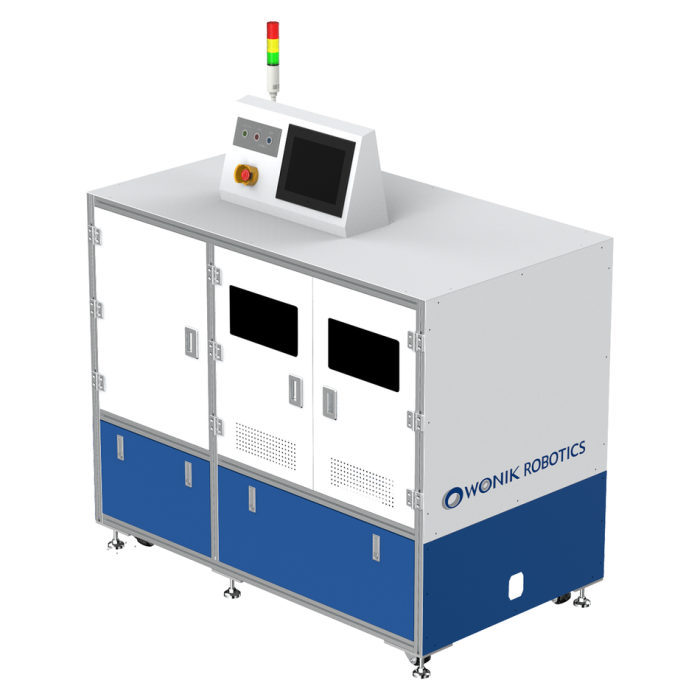
Wonik Robotics BCU Automatic Battery Replacement System
In stock
- MARCA:
- Wonik Robotics
- MODELO:
- BCU
- NÚMERO DE PIEZA #:
- BCU
- Warranty:
- 12 MESES
- AVAILABILITY:
- SUBJECT TO AVAILABILITY
- SKU:
- Wonik-BCU
Wonik Robotics BCU Automatic Battery Replacement System
Overview
The Wonik Robotics BCU is an automatic battery replacement station designed to support mobile robot fleets. According to the manufacturer, the system exchanges a depleted battery for a charged one automatically, rather than requiring the robot to remain docked while its battery recharges. The vendor describes this as supporting continuous mobile robot operation without charging-related interruption; this is a stated design intent, not an uptime guarantee, since actual continuity depends on fleet size, duty cycles, and system planning.
The BCU is an accessory battery replacement station, not a robot. It does not drive, carry loads, or perform tasks on its own. Instead, it serves mobile robots that approach it, performing automated battery pickup, exchange, charging, and discharge management.
Key Specifications
| Item | Specification |
|---|---|
| Battery replacement | Automatic, with power failure compensation (external power supplied) |
| Size (W x L x H) | 900 x 1,550 x 1,350 mm (3 slots; total height depends on number of slots) |
| Charging slots | 3 |
| Battery type, capacity | Li-ion, 25V 100A (manufacturer notation) |
| Battery weight | 15 kg (battery mass, not station mass) |
| Input power | 220VAC / 30A |
| Charging voltage | Max 29V |
| Charging method | Constant current / constant voltage (CC/CV), 4-step current increase after charging start (slow start) |
| Battery discharge management | Monitoring per charge level and automatic discharge |
| Battery pickup method | Magnet type (automatic detection / position correction) |
| Position correction range | X: +/-15 mm, Y: +/-15 mm |
| Position correction accuracy | +/-0.2 mm |
| Control panel | Touch panel / button |
| Battery replacement speed | Within 60 seconds |
| Emergency stop | 1 |
| Vision | 1 (battery pickup position detection and correction) |
| Alarm | 4-color indicator and warning sound |
| Ambient operating temperature | 0 to +40 degrees C |
| Floor requirements | No water, no oil, no dirt |
| Local communication (AMR) | RF PIO |
The manufacturer notes that battery specifications and the charging slot quantity can be changed, so the values above describe the documented three-slot configuration.
Understanding the Battery Specification
The source lists the battery as Li-ion with the notation 25V 100A, reproduced exactly as the manufacturer states it. No amp-hour (Ah) capacity is specified, and the 100A notation should not be read as 100 Ah or converted into watt-hours or an estimated runtime; the notation is ambiguous as a capacity statement, so buyers needing a confirmed energy figure should request that detail directly. Likewise, the 15 kg figure refers to the mass of the battery itself, not the mass of the station.
How the Replacement Process Works
The stated battery replacement speed is within 60 seconds; this is the time for the replacement operation itself, not a charging time. Batteries removed from a robot go into one of the three charging slots to recharge while the robot continues operating on a freshly charged pack.
Battery pickup uses a magnet-type mechanism with automatic detection and position correction. A single vision unit handles battery pickup position detection and correction, compensating for small misalignments when a robot presents its battery. The documented correction range is +/-15 mm on both the X and Y axes, with a correction accuracy of +/-0.2 mm, so the robot does not need to stop at a perfectly exact position as long as the battery sits within that window.
Charging and Battery Management
Charging follows a constant current / constant voltage (CC/CV) method with a maximum charging voltage of 29V. The station applies a 4-step current increase after charging starts, described by the manufacturer as a slow start; the source does not elaborate on its purpose, so no further claims are made about battery life effects.
The station also provides automatic charging management and discharge management that monitors packs per charge level and performs automatic discharge. It additionally supports power failure compensation when external power is supplied.
Operator Interface, Safety, and Environment
Operators interact with the BCU through a touch panel and buttons. One emergency stop is provided, and status is communicated through a 4-color indicator and a warning sound.
The documented ambient operating temperature range is 0 to +40 degrees C, and the floor must be free of water, oil, and dirt. The station requires 220VAC / 30A input power. The three-slot unit measures 900 x 1,550 x 1,350 mm (W x L x H), with total height depending on the number of slots.
Communication with Mobile Robots
For local communication with autonomous mobile robots (AMR), the source lists RF PIO. No further protocol detail is provided, so integration specifics beyond this listed interface should be confirmed with the manufacturer.
Planning Considerations
Some general considerations are worth reviewing as part of deployment planning rather than as product capabilities: whether the facility can supply the required 220VAC / 30A input, whether the installation area meets the clean, dry floor requirement, how many robots will share the station's three charging slots, and how robot traffic will be routed to the exchange position. Because battery specifications and slot quantity can be changed, confirming the exact configuration for a project is also a reasonable step.
Frequently Asked Questions
Is the Wonik Robotics BCU a robot?
No. The BCU is an accessory battery replacement station that automatically exchanges and charges robot batteries; it is not itself a mobile robot and does not perform transport or manipulation tasks.
How long does a battery replacement take?
The stated battery replacement speed is within 60 seconds. This refers to the swap operation itself, not the time required to recharge a battery, which occurs afterward in a charging slot.
What battery capacity does the BCU use?
The source lists the battery as Li-ion, 25V 100A, reproduced exactly as the manufacturer writes it. No amp-hour capacity is specified, and the figure should not be converted into Ah, watt-hours, or runtime estimates. Confirm capacity details with the manufacturer if needed.
How many charging slots does the station have?
The documented configuration has 3 charging slots. The manufacturer notes that slot quantity can be changed and that total station height depends on the number of slots installed.
How accurately does the station handle battery pickup?
Battery pickup uses a magnet-type mechanism supported by one vision unit for position detection and correction. The correction range is +/-15 mm in X and Y, with a stated accuracy of +/-0.2 mm.
What are the installation requirements?
The station requires 220VAC / 30A input power, an ambient operating temperature of 0 to +40 degrees C, and a floor free of water, oil, and dirt. The three-slot unit measures 900 x 1,550 x 1,350 mm (W x L x H).
Does the BCU guarantee continuous robot operation?
No. The manufacturer describes the system as intended to support continuous mobile robot operation without charging-related interruption. This is a stated benefit, not an uptime guarantee; actual continuity depends on fleet planning and operating conditions.
Summary
The Wonik Robotics BCU is an automatic battery replacement station for mobile robots, documented with 3 charging slots, Li-ion batteries listed as 25V 100A (no Ah capacity specified), 15 kg battery mass, CC/CV charging up to 29V, magnet-type pickup with +/-0.2 mm correction accuracy, and battery replacement within 60 seconds. With a 220VAC / 30A supply, 0 to +40 degrees C operating range, and RF PIO communication with AMRs, it serves as supporting infrastructure that keeps robot fleets working while batteries recharge in the station.
Request a quotation to confirm configuration, pricing and availability. Catalog stock status is not confirmation of physical inventory or immediate shipment.